Stele
The stele is the central cylinder of the stem (and roots) composed of:
Primary xylem
Primary phloem
Pith (if present)
Steles are commonly found in younger stems and some older stems and roots.
Types of Steles

Protostele

Siphonostele

Eustele
Why Steles Matter:
Show evolution of vascular organization
Help identify plant groups
Explain how stems efficiently transport water and food
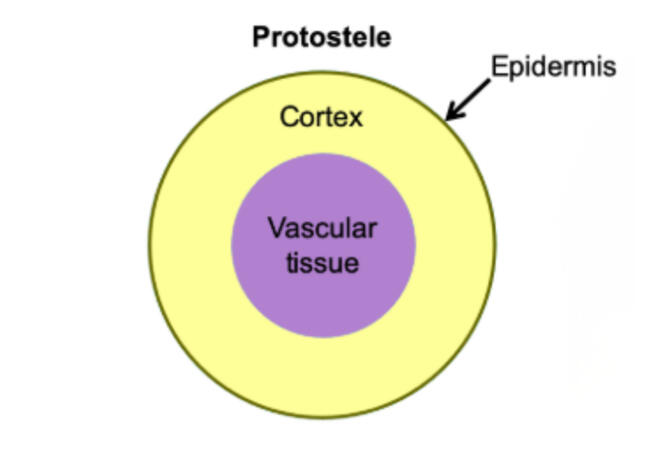
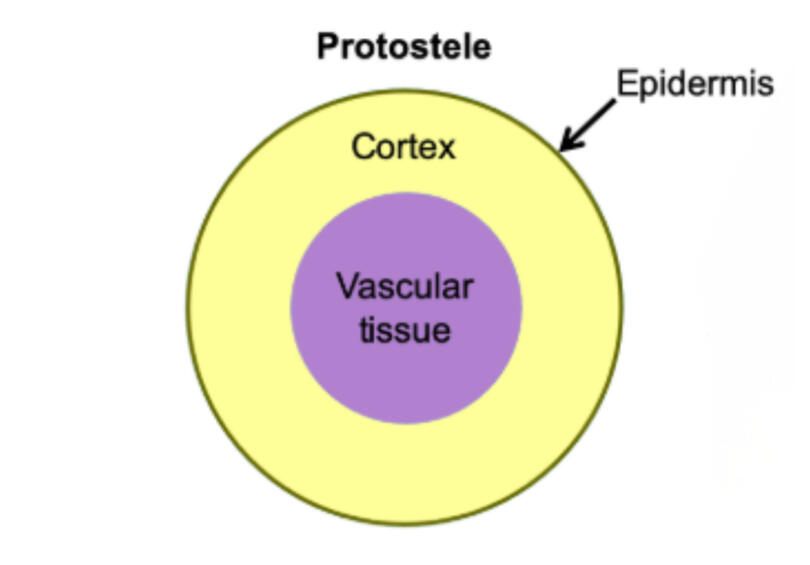
Protostele
Simplest and most primitive stele
Consists of a solid core of vascular tissue (xylem)
Phloem surrounds the xylem
No pith present
Common in primitive seed plants: Whisk ferns, Club mosses
Key Pattern:
✔ Solid vascular core
✔ No pith
Siphonostele
Tubular arrangement of vascular tissue
Pith is present at the center (parenchyma)
Xylem and phloem form a cylinder around the pith
Common in ferns
Key Pattern:
✔ Hollow center (pith)
✔ Vascular tissue forms a tube
Eustele
Found in present-day gymnosperms and flowering plants (dicots)
Primary xylem and phloem are arranged in discrete vascular bundles
Bundles are arranged around the pith
✔ Vascular tissue divided into bundles
✔ Advanced stele type
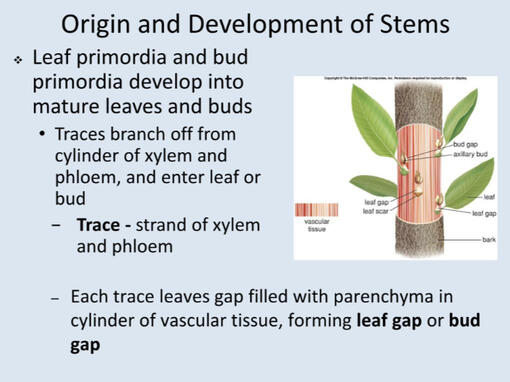
Origin of stems
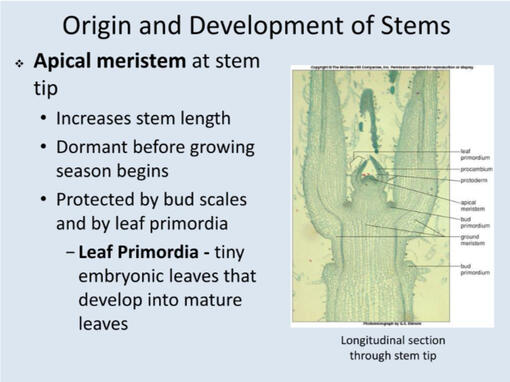
Arises from the plumule of the embryo
Develops from the shoot apical meristem
Forms the primary shoot system (stem, branches, leaves)
Primary Development
Controlled by the apical meristem
Increases length of the stem
Produces nodes and internodes
Forms primary tissues: epidermis, cortex, pith, primary xylem and phloem
Secondary Development
Controlled by lateral meristems
Vascular cambium → secondary xylem (wood) and secondary phloem
Cork cambium → bark
Increases girth/diameter of the stem
Common in dicots and gymnosperms
Stem Modifications (Developmental Variations)
Underground: rhizome, tuber, bulb, corm
Sub-aerial: runner, stolon, sucker, offset
Aerial: tendrils, thorns, cladodes, phylloclades
Botanical Significance
Provides support and conduction
Enables photosynthesis and storage
Essential for plant growth and survival
Taxonomic Importance
Stem structure used in plant classification
Arrangement of vascular bundles
Presence or absence of secondary growth
Type of stem modification
Distinguishes monocots, dicots, and gymnosperms